Lessons From a Winter Walk
Disclaimer: It feels a bit uncomfortable to have a platform to write about Covid-19. All of us are struggling under the weight of not only the impact of the virus itself, but also the need to make meaning out of what we are collectively experiencing. As Dan mentioned, my personal reflection can’t fully speak to the grief and hardship created by Covid-19, nor can it compare to the truly heroic efforts being made by many of our community members during this pandemic. While acknowledging this, I find relief when others share in authentic self-expression, and my hope in joining that effort is that we can continue to support one another in these efforts of meaning-making by connecting through social media via these and other types of storytelling in the coming weeks and months.
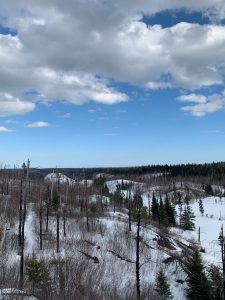
Many people have been telling me recently how they wish they could be in my shoes, which are holed up at Wilderness Canoe Base during this global crisis that requires many of us to stay home. I have the privilege of living and working year–round at camp, and I am lucky enough to be able to simply walk out my front door and be in magnificent wild spaces. As we seek out ways to decompress and get away from the wall of Covid-19 news that consistently puts our minds in a state of worrying about an unknowable future, I’ve been trying to get outside regularly and use the outdoors to guide my thoughts back into the present and just be. What I had forgotten until a few days ago, however, is that exploring the wilderness can sometimes be hard and uncomfortable.
Last week, I set out on a nearby hiking trail that I’ve done many times before. It was a brilliant, warm sunny day and I was anticipating the feeling of my worries melting away as I got my body moving and exchanged my computer screen for blue skies and tall trees. But the wet snow on the trail make hiking incredibly challenging; I couldn’t be sure if the snow ahead of me would hold me up or send me sinking through to my knees. Midway through my hike, I was raging with tears of frustration. My body hurt. I was so discouraged to be failing at what was supposed to be my form of self-care. I was embarrassed that this fairly easy hike was giving me so much trouble. I was even annoyed at my dog who was loving every second of this hike with no regard for my misery.
It’s easy to forget that wilderness experience, while being full of beauty and simplicity and wonder, can also force us to face feelings of discomfort. Many of us can relate to bouts of physical and emotional pain while adventuring; we’ve been on muddy portages that suck the shoes right off our feet, we’ve furiously paddled into the wind without making any forward progress, and we have endured merciless black flies and mosquitos that drive us into our cramped tents at night. And these kinds of experiences allow us to be fully immersed in our discomfort in ways that our culture often seeks to avoid. We often grow uneasy at the thought of discomfort within ourselves and among our communities. We don’t know what to say to our sick friends and grieving colleagues and despondent family members. We want to distract, numb, and move beyond these kinds of feelings as quickly as possible.
But when you are on a portage that seeks to literally swallow you and your canoe into its muddy depths, (or a snowy trail where you can’t find a solid footing), it’s clear that the only way out is through. Many of us have this experience of being in the wilderness, staring down a hard and painful thing ahead of us, and determinedly diving right into it. In these times of global panic, my hope is that we can call upon this aspect of our wilderness experience to help us through our discomfort stemming from our new reality. We can rest in the knowledge that we are resilient. These hard feelings and sensations will not be the end of us, just as no portage will last forever. And we are not alone. Anyone who has ever accepted a “bridge” from a fellow camper knows that when we share the load of our heavy burdens, we can ultimately keep going for longer than if we try to hide our struggle and push through by ourselves.
So my friends, my prayer for you is that you have the strength to feel anything that bubbles up from your heart and mind, knowing that you are incredibly resilient and that there is a cloud of witnesses who are ready to walk alongside you and help you bear the load. Amen.
-Kristin, WCB Site Manager
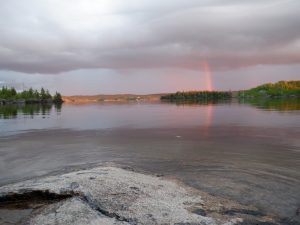 Canoe trips help me to come up against the limitations of what I can control. When I’m headed out “on trail” (into the woods for a camping trip), I make lots of lists. Lists of things to buy, things to organize, things to do. My packing lists are so extensive that I usually arrange them by the pack that the listed items will live in over the course of the trip, and sometimes even by the pack-within-the-pack. Here’s an excerpt from last summer’s “Back-up Small Equipment List,” the subcategorized contents of which were stored in a blue 5-liter dry bag that I tucked into the bottom corner of my food pack:
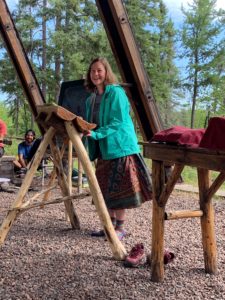 I don’t usually start sermons this way… but since this ground is the holiest ground I ever get to stand on, I am going to read a tiny bit from Moses’s encounter with God. God appears in a burning bush and says, “Moses! Remove the sandals from your feet, for the place on which you are standing is holy ground.” In honor of this holy ground… that is part of the Band of Brothers Chapel on Dominion Island in Seagull Lake… I am ditching my shoes. And if you want to, you can too.
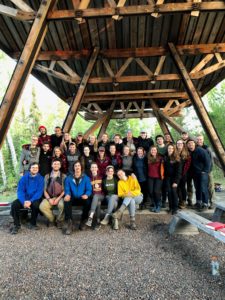 Throughout this past summer, campers, guests, and staff associated with Lake Wapogasset Lutheran Bible Camp, Inc. had opportunities to talk and learn about their faith through an overarching theme of, ‘Claimed, Wildly Loved By God.’ At its essence, this theme tells us that God loves us wildly and unconditionally. In a world that often makes us feel like we are ‘not enough,’ the message of God’s abounding love for us is a message of hope and assurance, and a message that we are created in God’s image and are in fact more than enough.
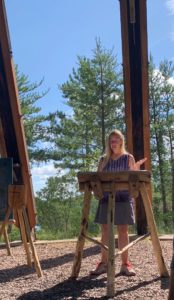 How many of you feel the call to the wilderness? For many of you I would guess that is why you are here, a continual call into the Wilderness. What does that call to the wild feel like? Is it something you can feel in your gut, a warming in your heart, or a peacefulness in your mind. Maybe the feeling is hard to articulate but the visceral longing and need to be in the wild is undeniable for many of you. Over the last several days as I’ve been listening to reflections of groups coming off the trail and I can’t help but think about when these groups first arrived to camp. What is going through the thoughts and feelings of these groups when they set foot on the cove and look across the lake not knowing what is ahead of them. At that moment through all of the fear, excitement, and car sickness – Are they being called into the wilderness or are they sent? The same question may be asked of all of you today – whether you are staff, campers, guests, were you called to be here or sent?
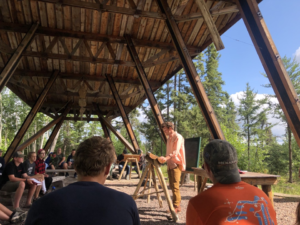 I’m Dan. I guide canoe trips at Wilderness Canoe Base this summer. Today, I’d like to talk about peace.
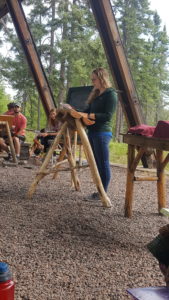 Anyone who has had a conversation with me in the last few days has probably heard me thinking out loud, often, with incredulity, and without much regard for the parameters of what we generally consider to be normal conversation, about how I can’t wrap my head around the symmetry of our reading from Exodus this morning and the news coming out of Sudan these past days and weeks.Tragically, the common thread between these two things is dead bodies in the Nile River. Yes – we are getting very serious, very quickly here. But leaning on the strength of our community and God who is the God of hope and justice, we will sit together with this difficult text buttressed against our difficult reality. And then, I hope, our community will continue the work we have already begun, which is to be the hands and feet of a God who organizes.<